
The De La Warr Pavilion: An East Sussex Photographers Perspective on Bexhill's Iconic Landmark


The De La Warr Pavilion has been part of my life for as long as I can remember. Growing up in Bexhill-on-Sea, it was always there on the seafront — a building that felt both familiar and quietly extraordinary. Over the years, I have been lucky enough not only to live alongside it, but to work inside it as a photographer. From early morning light across the terraces to evenings filled with music, art, and people, the Pavilion has become something I know intimately, both personally and professionally.

Designed by modernist architects Erich Mendelsohn and Serge Chermayeff, the De La Warr Pavilion opened in 1935, built at a cost of around £80,000. Commissioned by Herbrand Sackville, 9th Earl De La Warr, it was conceived as a progressive space — somewhere that embraced new ideas, culture, and accessibility. Nearly ninety years on, it still feels forward-thinking, which is a rare achievement for any historic building.

As a photographer, the Pavilion is endlessly inspiring. Its clean lines, sweeping curves, and changing relationship with light make it one of the most photogenic buildings in East Sussex. But it’s not just the architecture that matters — it’s the life inside it. Over the decades, the Pavilion has hosted exhibitions by artists such as Pablo Picasso, Joan Miró, Henry Moore, and Barbara Hepworth, while its stage has welcomed legendary musicians including Bob Marley, who performed here in 1978, as well as David Bowie, Jimi Hendrix, and Patti Smith. Knowing that this level of cultural history exists in a town like Bexhill still feels remarkable.

The Pavilion’s continued survival hasn’t happened by chance. People like Suzy Eddie Izzard played a crucial role in championing its future, particularly during her time as Chair of the De La Warr Pavilion Trust. Her work helped secure funding, raise awareness, and reinforce the idea that this building should be open, inclusive, and relevant to everyone. That commitment can be felt today in how the space is used — not as a relic, but as a living part of the town.

The recent £17 million grant for essential remedial works is a vital step in protecting that future. Historic buildings like this require care, and investment ensures the Pavilion can continue to welcome artists, audiences, and visitors to Bexhill-on-Sea. It also plays a quiet but important role in the local economy, bringing people to the town and supporting nearby businesses along the south coast of England.

Bexhill’s wider setting makes the Pavilion even more meaningful to me. Just along the coast lies Hastings, an ancient fishing town, and nearby is the site of the Battle of Hastings in 1066, one of the most significant events in British history. Living and working in this part of East Sussex, it’s impossible not to feel the weight of history — and the De La Warr Pavilion represents the modern chapter of that story, sitting confidently alongside centuries of heritage.
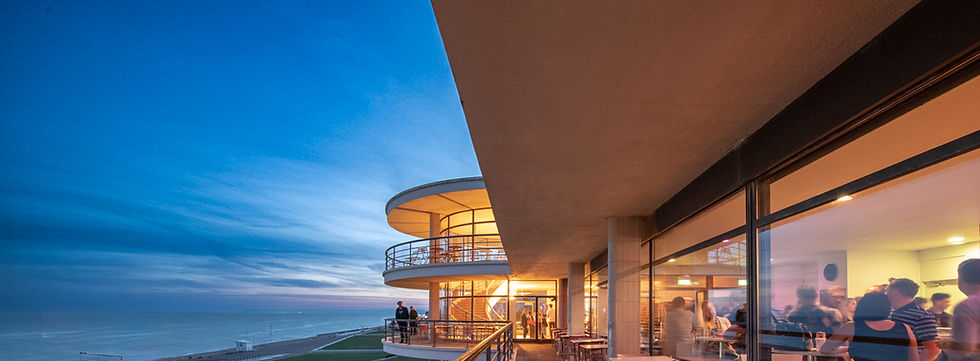
For me, the Pavilion isn’t just an iconic building or a photography subject; it’s part of everyday life in Bexhill. It’s a place people walk through, meet in, photograph, and return to again and again. The current restoration work is something to be welcomed, ensuring this extraordinary modernist landmark continues to inspire creativity, bring people together, and remain a defining feature of Bexhill and East Sussex for generations to come.
The images I have chosen are just a few of my favourite images of this magnificent architectural statement that lies on our doorstep here in Bexhill-on-Sea East Sussex.
That kind of connection happens when a building stops being just a structure and becomes a witness to your life.

When you grow up with a place like the De La Warr Pavilion, it quietly absorbs your memories. It’s there in the background of ordinary days and significant moments alike, until it becomes inseparable from your sense of home. Over time, you don’t just recognise its shape or history — you recognise how it feels. The light at certain times of day, the sound of the sea against it, the way people move through it. Those things settle into you, especially when you return again and again with a camera in your hands.
Photographing a building deepens that bond. When you’re asked to document an event, a workshop, or even something as simple as a repair, you’re being trusted to observe and preserve moments in its ongoing story. You’re not just recording what’s happening; you’re adding another layer to its archive. Repairs aren’t mundane in that context — they’re acts of care, signs that the building is still alive and valued. Being present for those moments makes the relationship feel personal because, in a quiet way, you’re helping to look after something that has given you so much.

There’s also an element of responsibility. When a building has shaped your creative eye and provided a space where art, music, and people continually meet, photographing it can feel like a form of stewardship. You’re translating its atmosphere and significance for others — for those who were there, and for those who weren’t. That sense of guardianship is why even the most routine commission can carry emotional weight.
All images by Matthew Harmer (www.burstphotos.co.uk) Photographer based in Bexhill.

De La Warr Pavilion Events De La Warr Pavilion Events De La Warr Pavilion Events De La Warr Pavilion Events De La Warr Pavilion weddings De La Warr Pavilion Bexhill De La Warr Pavilion- Eddie Izzard De La Warr Pavilion- Eddie Izzard De La Warr Pavilion- Eddie Izzard


Comments